It’s in my Blood Group B +ve.
Introduction
Today, IT has become a huge agent of change in different business aspects of the society. It is a game changer when it comes to the resolving the social and economic issues. Technology is revolutionizing the way we do business and making high-tech approaches as an integral part of our lives. As an IT professional, if you want to be ahead of the competition, you will need to know the latest trends and events occurring within the industry. Here is the brief intro about some of the top technologies which is going to evolve more in the near future.
AI-as-a-service
Artificial Intelligence is one of the most revolutionizing technologies of this Era and in 2020 it is going to boom even more. Artificial Intelligence as a Service (AIaaS) is the third party offering of artificial intelligence (AI) outsourcing. AI as a service allows individuals and companies to experiment with AI for various purposes without large initial investment and with lower risk. Coupled with staffing and maintenance costs, as well as hardware changes for different tasks, makes AIaaS cost prohibitive to many organizations. AI cloud offerings including Amazon Machine Learning, Microsoft Cognitive Services and Google Cloud Machine Learning, which can help organizations what might be possible with their data.
Cybersecurity
With the widespread use of the IT ecosystem, Cyber security remains one of the major concerns for most of the companies.
Cyber security refers to the body of technologies, processes, and practices designed to protect networks, devices, programs, and data from attack, damage, or unauthorized access.
The upcoming years are going to be years to converge multiple cybersecurity trends due to the automation of cyber security as well as the development of public IT infrastructure. Multiple companies increase the security budget year by year towards malicious threats as well as a response to the recent data privacy legislation. Top notch companies such as IBM, HackerOne, FireEye and Cisco are making it to the top 150 companies for cyber security.
Hyper Automation
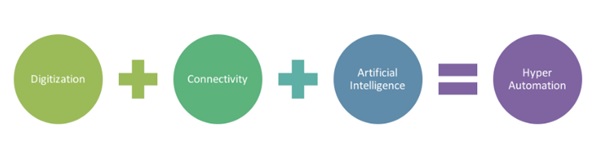
Digitization of processes, improved connectivity with the help of the Internet, and smarter machines with artificial intelligence has led the world into an age of hyper-automation. As a result, today, the expansion of hyper-automation cannot be neglected. Understanding the automation mechanisms and how it is controlled and coordinated using machine learning will be a main focus of this field.
In the coming years, hyper automation is implied to have a major macroeconomic implication on the market. Hence top gear companies need to gear up for this convergence in demographic shifts. As of now Companies such as Wipro and Infosys are experimenting with this technology. But other companies are not very far behind.
DevOps
DevOps is the offspring of agile software development – born from the need to keep up with the increased software velocity and throughput agile methods have achieved. Advancements in agile culture and methods over the last decade exposed the need for a more holistic approach to the end-to-end software delivery lifecycle.
DevOps is an IT mindset that encourages communication, collaboration, integration and automation among software developers and IT operations in order to improve the speed and quality of delivering software. Achieving this via the build, validate, and deploy and delivery stages, while empowering cross-functional teams with full ownership of software applications – from design thru production support.
DevOps made its way to Artificial Intelligence through Data Ops. With the increasing use of microservices, DevOps continues to pay with its way into our big players like NASA, Netflix, Capgemini and dell, which are a few of existing pioneers in this industry.
IoT – Internet of Things
The Internet of Things (IoT) is a system of interrelated computing devices, mechanical and digital machines, objects, animals or people that are provided with unique identifiers and the ability to transfer data over a network without requiring human-to-human or human-to-computer interaction.
An IoT system consists of sensors/devices which “talk” to the cloud through some kind of connectivity. Once the data gets to the cloud, software processes it and then might decide to perform an action, such as sending an alert or automatically adjusting the sensors/devices without the need for the user.
By the year 2020 it is estimated that around 75 billion connected devices going to exist on the face of this globe. IoT is also paving the way for Edge Computing. For enterprises to keep up with the technological trends, they have to build their infrastructure upon Edge base design patterns. There are few front runners in this particular market, like AWS, Cisco, Microsoft, Dell and HP.
3D Printing Technology
Revolutionizing the future, 3D printing is one of those technologies you should definitely look forward to, in the upcoming years, in the future. It is said to completely change the face of domain such as healthcare, manufacturing and construction.
3D printing or additive manufacturing is a process of making three dimensional solid objects from a digital file. The creation of a 3D printed object is achieved using additive processes. In an additive process an object is created by laying down successive layers of material until the object is created. Each of these layers can be seen as a thinly sliced horizontal cross-section of the eventual object.
Big brands such as Bugatti, BMW, Adidas, Audi and Porsche are already on their way to remodel a future using 3D printing.
DARQ
This is a future technology pattern consisting of other big technologies. It is considered to be a catalyst for change in the post digital world. DARQ is an acronym.
D – Distributed Ledger – First gained its momentum in the industry with the introduction of block chain and Bitcoin.
A – Artificial Intelligence – Which is bringing about tremendous change in various domains
R – Extended Reality – including augmented reality and virtual reality
Q – Quantum Computing – Means, you’re trying to create IT technology based off of the principles of quantum theory.
Recently google has made a major breakthrough by attaining Quantum supremacy. With 53 qubits of quantum processors, it has successfully carried out a random circuit program a million times in 200 seconds, which otherwise would have taken ten thousand plus years by traditional computing. At this moment 9 out of 10 businesses experimenting with one or more DARQ technologies.
While each individual technology is at different level at the adoption curve, the first wave of DARQ technologies is coming soon.
Big Data
Big data is a term that describes the large volume of data – both structured and unstructured – that inundates a business on a day-to-day basis. But it’s not the amount of data that’s important. It’s what organizations do with the data that matters. Big data can be analyzed for insights that lead to better decisions and strategic business moves.
When you combine big data with high-powered analytics, you can accomplish business-related tasks such as:
- Determining root causes of failures, issues and defects in near-real time.
- Generating coupons at the point of sale based on the customer’s buying habits.
- Recalculating entire risk portfolios in minutes.
- Detecting fraudulent behavior before it affects your organization.
Companies which are investing in big data, include Netflix, Amazon, Starbucks, Spotify and Adobe. While we are on the topic of Big Data, there is another buzz word in the industry, which is Dark Data. Dark data is all this data that is generated along with big data, but is untapped. And by the year 2020 about 93% of all data is going to be categorized under this subset.
5G Technology
5G is the 5th generation mobile network. It will take a much larger role than previous generations. 5G will elevate the mobile network to not only interconnect people, but also interconnect and control machines, objects, and devices. It will deliver new levels of performance and efficiency that will empower new user experiences and connect new industries. 5G will deliver multi-Gbps peak rates, ultra-low latency, massive capacity, and more uniform user experience. It is expected to give a minimum of 20 Gbps downlink and 10 Gbps uplink which would make it 40 times faster than the current 4G LTE technology. Companies engaged heavily in the development and testing of 5G equipment are Samsung, Huawei, Intel, Ericsson, Nokia, Deloitte and Qualcomm.
Cognitive Cloud Computing
Cognitive computing describes technologies that are based on the scientific principles behind artificial intelligence and signal processing, encompassing machine self-learning, human-computer interaction, natural language processing, data mining and more. Its aim is to solve complex problems characterized by uncertainty and ambiguity, which in other words means problems that are only solved by human cognitive thought.
It can converse in natural language and helps in decision-making by understanding the complexities of Big Data. Hence big companies such as IBM, Microsoft, Google and Cisco are already investing in this next generation technology to keep up with the upcoming market.
 Dynamics 365